
Why I scrubbed AI Overviews from my Google Searches

Updated: Jan 29
You know those little blurbs at the top of your searches that summarize the answer for you? I don't see those anymore, by choice.
This is going to be a bit of a different entry, by the way. Usually, I only post here when I have something to share that might be helpful for entrepreneurs or nonprofits trying to manage their own marketing. That's who I primarily work with, and it's sometimes useful to have space to share thoughts on that topic that don't warrant a permanent page on my site.
This isn't that. This, my friends, is me working through what I think about a complicated topic. As John Warner says in his excellent book More than Words, "writing is thinking."
I needed to think. So, I'm writing.
I have been musing about AI search, specifically, since a course I taught last December. I wanted to show my students an example of good organic SEO - how you can create content on your website that answers queries in your field to help draw people in and build authority.
For the last few years, my go-to example of this has been a real ZMOT search I conducted in a flurry of pandemic renos: "How much does a patio cost in Winnipeg?"
To this day, if you do that search the first organic result will be an excellent blog from Earthworks Landscaping. It not only outlines a range of prices per square foot, it also breaks down real examples of patios they've installed in Winnipeg. This isn't some listicle "top 10 things you need to know when putting in a patio." It's clearly written by a real person with actual local experience, and I took notice. When I decided to go ahead, I used Earthworks partially because their website had already built up a lot of trust and authority before I'd even requested a quote (they also did a great job).
It's a good local example of effective organic marketing, and I've pointed to it many times over the years. But when I went to take a screenshot of the search for this class, I realized something:
The Earthworks blog is still the #1 organic search result for "how much does a patio cost in Winnipeg?" But now, not only is that result buried under sponsored results (which it always was), it's also lost beneath a prominent AI overview that eats up most of the above-the-scroll space:
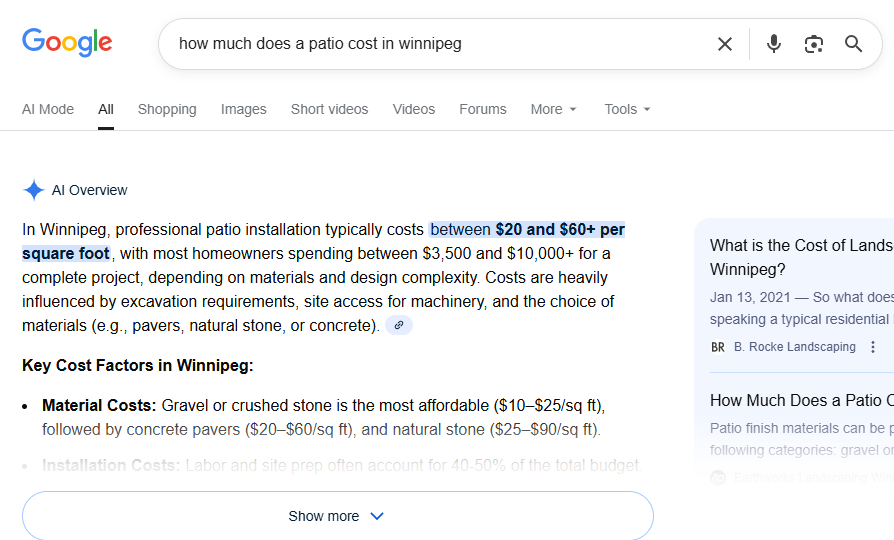
What are the chances you, as a searcher, are going to even click on another link when the answer "$20-$60+ square foot" is right in front of you (and helpfully highlighted to boot)?
No need to scroll down. No need to click or check out anyone else's website. The only entity gaining feelings of trust and authority in this situation is Daddy Google.
Is this a problem? Depends how you look at it. Maybe you think you don't have time to look through the results to get your answers. Or maybe you think that marketing in itself is manipulative (ouch) and getting information in this way is somehow purer or cleaner than going to a third-party website for expertise.
But the thing is, Google isn't actually an authority on anything.* It doesn't know diddly squat. Just like LLMs, everything Google "knows" it scrapes and repackages from somewhere else, stealing that information and authority from actual people and sites to make sure you never have to leave the safe Google bubble.
The more I thought about that, the more I started to feel icky.
It would be misleading for me to pretend I'm anti-AI. I use LLMs quite a bit, for thinking and for organizing. I have a paid subscription to Claude. AI has become a useful tool in my work arsenal, especially when structuring lesson plans or working my way through a tricky/thorny idea.
But I've become more and more cautious about how often I use it. Partially because I'm aware that every time I do, I'm consuming an inordinate amount of resources. I can (cautiously) justify those resources when I'm structuring my lesson plans for a classroom full of students, or synthesizing workbook content for a full-day workshop. But I can't justify them to create a silly slop video of myself as a cat, or to make an email sound "a little more friendly" when I could do that myself if I just took an extra 2 minutes.
2 minutes of my time isn't worth a bottle of water.**
So yes, the impact of my AI use on the environment is a concern to me. But in the case of hiding my search overviews, I'm more worried about the impact of AI use on my brain.
Much smarter people than I have written extensively on what regular use of AI is doing to our brains. I've read a lot of the science, but what I actually think of most often is a comedy sketch I saw where someone was at the gym working out and claimed they were using a new "lift support" bar for their bench presses. "It helps lift the weight so I can save my strength for the important stuff!" they crowed.
"Good thing too," the weight lifter told their friend. "I tried to pick up my toddler the other day, and I could barely manage it. Just imagine how much I would have struggled if I hadn't been saving all that extra energy!"
Touché.
If I keep opting out of using my brain--to rewrite things, to think through things, to make the stuff I create better--those skills will atrophy. Eventually, I won't be able to lift anything at all.
I'm not going to stop using AI completely. I know some people have, and I understand the argument. But there are places in my work where I know it's making the output better. Where it's helping me organize, or synthesize, or think things through in a way that's thought-provoking and additive. (I'm particularly fond of asking Claude to ask me probing questions to dig into something I'm putting together and see if it really stands up - I highly recommend it). For now, those trade-offs seem worth it to me.
But I don't want AI to just offer me quick information anymore. I don't want it to be integrated into everything I do, to offer up isolated information scraped and removed from its sources so my brain doesn't have to do any lifting.
I want my brain to keep getting stronger.
So much of the push of modern life is designed to make things frictionless. Get it delivered, buy with one click, just ask Siri.
But friction is where we get growth. Where the interesting stuff happens. Where the unexpected creeps in. It's also how we protect against the tsunami of inertia that seems to be sweeping our world (when our brain gets too used to no friction, even a tiny bit feels not worth it. Better to just DoorDash and watch Netflix).
If we want to grow, we need to embrace some friction. I'd even go as far as to say if we want to be happy, to be fulfilled, some friction is essential. Not everything needs to be hard, but making everything easy is the path to unfulfillment.
So I'm going to hide the search overviews. I'm going to click on the links. I'm going to read the information where it actually is.
It's going to take me an extra minute. It's going to make me think a tiny bit harder.
Maybe that's actually the point.
*except being a monopoly--but that's a different (though not unrelated) story.
**or whatever exact liquid amount it actually is - I'm aware estimates differ.
Notes:
For those who are interested, this is the plugin I installed to hide my AI overviews (as well as a bunch of other stuff that was cluttering up my search results): Bye Bye, Google AI
I have often used AI to "polish" my writing - typing out a rough first draft and then getting AI to do the organization and clean-up work. In the spirit of this post, I made an active choice to do all the editing myself. It was good friction.


Comments